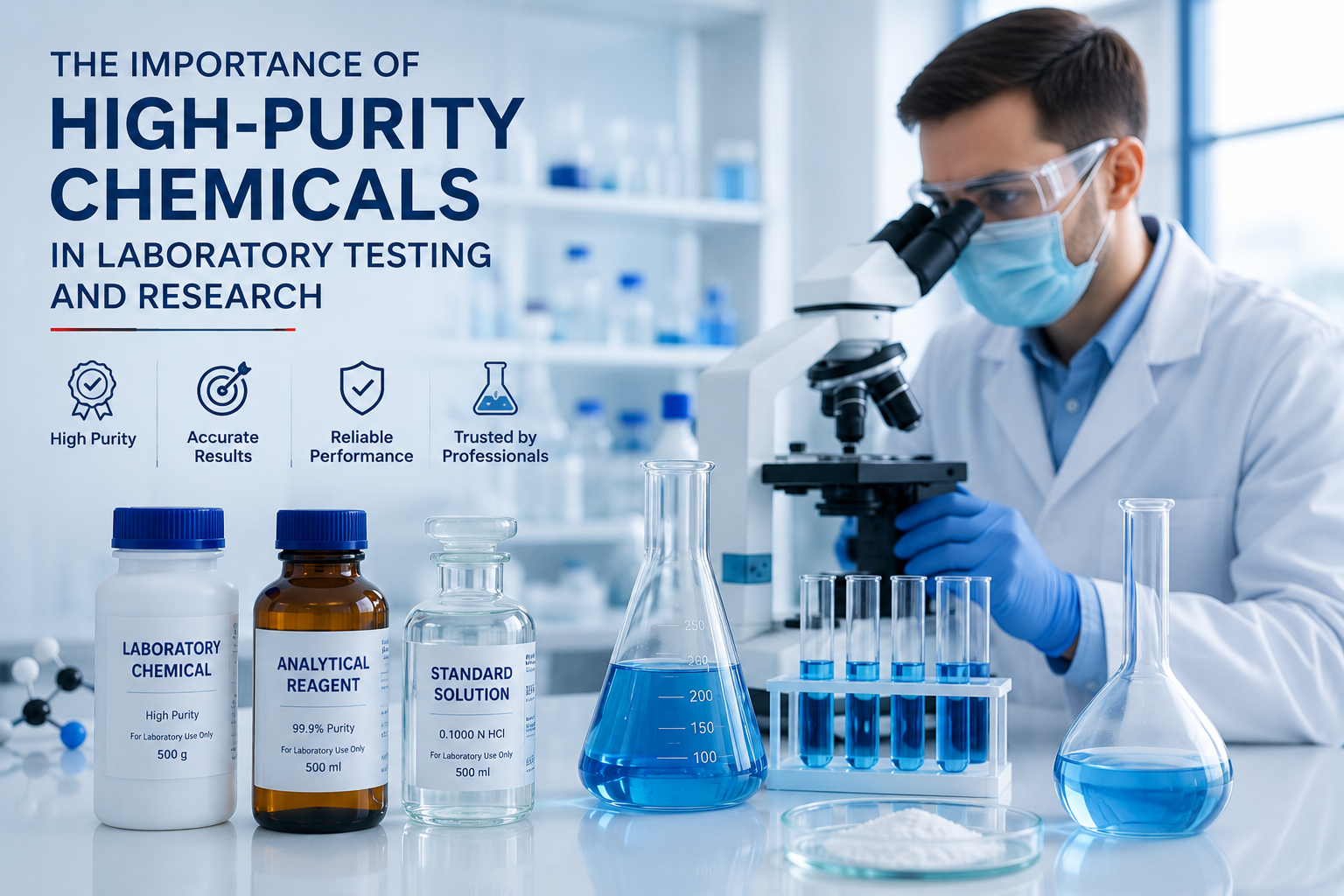
Laboratories are the foundation of scientific discovery, industrial innovation, healthcare advancement, and quality assurance. Whether conducting research, developing new products, testing raw materials, or performing routine analysis, laboratories depend on one essential factor to achieve reliable results: the quality of the chemicals being used.
High-purity laboratory chemicals are not simply materials used during experiments; they are critical components that directly influence the accuracy, consistency, and reliability of analytical outcomes. Even the most advanced laboratory equipment and highly trained professionals cannot compensate for poor-quality reagents or contaminated chemicals.
As scientific industries continue to evolve and analytical requirements become increasingly demanding, the need for dependable chemical products has never been more important.
Understanding Chemical Purity
Chemical purity refers to the percentage of the desired substance present in a product and the absence of unwanted contaminants or impurities. In laboratory environments, even trace amounts of contamination can significantly impact test results, particularly when dealing with sensitive analytical methods.
For example, in pharmaceutical laboratories, a minor impurity can interfere with drug development studies and quality control procedures. In environmental testing laboratories, contamination may lead to inaccurate measurements that affect regulatory compliance. Similarly, in research institutions, impurities can compromise experimental outcomes and limit the reproducibility of scientific findings.
This is why laboratories around the world prioritize the use of high-quality reagents and chemicals that meet strict purity standards.
Why High-Purity Chemicals Matter
Improved Accuracy
Accurate data is the foundation of every successful laboratory operation. High-purity chemicals help eliminate variables that could influence measurements, allowing scientists and technicians to generate dependable results.
Whether performing titrations, chromatography, spectroscopy, or other analytical procedures, the use of premium-quality reagents improves confidence in the final data.
Enhanced Reproducibility
Scientific experiments and laboratory analyses must be reproducible. Results obtained today should be achievable tomorrow under the same conditions.
When laboratories use consistent, high-quality chemicals, they reduce variations between experiments and ensure more reliable outcomes over time. This consistency is particularly important for research projects, quality control programs, and industrial testing procedures.
Increased Laboratory Efficiency
Using inferior chemicals often leads to repeated testing, troubleshooting, and additional validation procedures. These issues can consume valuable time, increase operational costs, and delay important decisions.
High-purity chemicals contribute to smoother workflows by reducing unexpected results and helping laboratories operate more efficiently.
Regulatory Compliance
Many industries operate under strict quality and regulatory requirements. Pharmaceutical manufacturers, food producers, environmental laboratories, and medical institutions must comply with established standards and guidelines.
The use of reliable laboratory chemicals supports compliance efforts by ensuring that analytical procedures are performed using materials that meet recognized quality specifications.
Applications Across Multiple Industries
High-quality laboratory chemicals are essential in a wide variety of industries and scientific disciplines.
Research and Academic Institutions
Universities and research centers rely on laboratory chemicals for scientific investigations, educational activities, and innovation projects. Reliable reagents help researchers produce accurate findings and advance scientific knowledge.
Healthcare and Medical Laboratories
Clinical laboratories require dependable chemicals for diagnostic testing, sample analysis, and medical research. Precision and consistency are critical when laboratory results influence healthcare decisions.
Pharmaceutical Industry
Pharmaceutical laboratories use analytical chemicals throughout drug development, quality control, formulation testing, and manufacturing processes. High-purity reagents help ensure product safety and effectiveness.
Industrial Quality Control
Manufacturing facilities depend on laboratory testing to verify raw materials, monitor production processes, and evaluate finished products. Accurate analysis supports product quality and customer satisfaction.
Food and Beverage Testing
Food laboratories utilize chemical reagents to assess quality, detect contaminants, and ensure compliance with safety standards. Reliable testing helps protect consumers and maintain industry standards.
Environmental Monitoring
Environmental laboratories analyze water, soil, air, and waste samples using specialized chemicals and analytical methods. Accurate measurements are essential for environmental protection and regulatory compliance.
The Role of Quality Assurance in Chemical Manufacturing
Producing reliable laboratory chemicals requires much more than manufacturing expertise. It involves a comprehensive quality assurance system designed to maintain consistency throughout every stage of production.
Quality assurance begins with the careful selection of raw materials from trusted suppliers. These materials are evaluated and tested before entering the production process.
During manufacturing, strict controls help ensure product consistency and prevent contamination. Products are then subjected to detailed quality testing to verify compliance with established specifications.
Packaging and storage procedures are equally important. Proper packaging protects product integrity, while controlled storage conditions help maintain stability and performance throughout the product’s shelf life.
The goal of these quality assurance measures is simple: to provide laboratories with chemicals they can trust.
Choosing the Right Chemical Supplier
Selecting a chemical supplier is an important decision that can significantly impact laboratory performance.
A reliable supplier should offer:
- Consistent product quality
- Comprehensive quality control procedures
- Technical expertise and support
- Dependable product availability
- Clear product documentation
- Responsive customer service
Laboratories should seek partners who understand scientific requirements and are committed to supporting long-term operational success.
Orbital Chemicals: Supporting Scientific Excellence
At Orbital Chemicals, quality is at the center of everything we do. We understand that laboratories require more than just chemical products—they need confidence in every result, every analysis, and every experiment.
Our commitment to excellence is reflected in our manufacturing processes, quality assurance procedures, and customer-focused approach. From high-purity solvents and laboratory acids to standard solutions and specialized reagents, we strive to provide products that meet the highest expectations for performance and reliability.
We continuously work to support laboratories, research institutions, hospitals, and industrial facilities by delivering chemical solutions that promote accuracy, consistency, and scientific progress.
Conclusion
The quality of laboratory chemicals directly influences the quality of laboratory results. High-purity reagents contribute to accurate measurements, reproducible outcomes, improved efficiency, and greater confidence in scientific work.
As laboratories continue to face increasingly complex challenges, the importance of reliable chemical products will only continue to grow. By choosing trusted suppliers and maintaining high standards, organizations can strengthen their analytical capabilities and achieve better results across every application.
At Orbital Chemicals, we remain dedicated to empowering science through quality, precision, and innovation—helping laboratories transform research into reliable results and scientific potential into real-world success.
Orbital Chemicals — From Research to Results.